


Most homeowners hiring an upholstery cleaner for the first time assume that the difference between services is mostly price and scheduling. That’s understandable — from the outside, it looks like a commodity service. Someone comes, sprays something, runs some equipment, leaves. But the spread in actual results is wider than almost any other home service category, and the reasons have nothing to do with effort or friendliness. They have to do with whether the person you hired actually understands upholstery — or whether they primarily clean carpet and added sofas to their menu because the equipment overlaps.
This distinction matters more in practice than most people realize until they’ve had a bad experience. A carpet cleaner using carpet cleaning methods on a sofa can leave watermarks on a fabric coded for solvent-only cleaning, crush the pile on a velvet cushion, or over-wet the foam so thoroughly that the couch smells like mildew three days later despite looking clean on the surface. None of this is malicious — it’s a knowledge gap. Upholstery cleaning is genuinely a different discipline from carpet cleaning, and not everyone who does one is qualified to do the other.
Here’s what actually separates the skilled services from the ones that will leave you with a worse problem than you started with.
The First Signal Comes Before They Touch the Couch
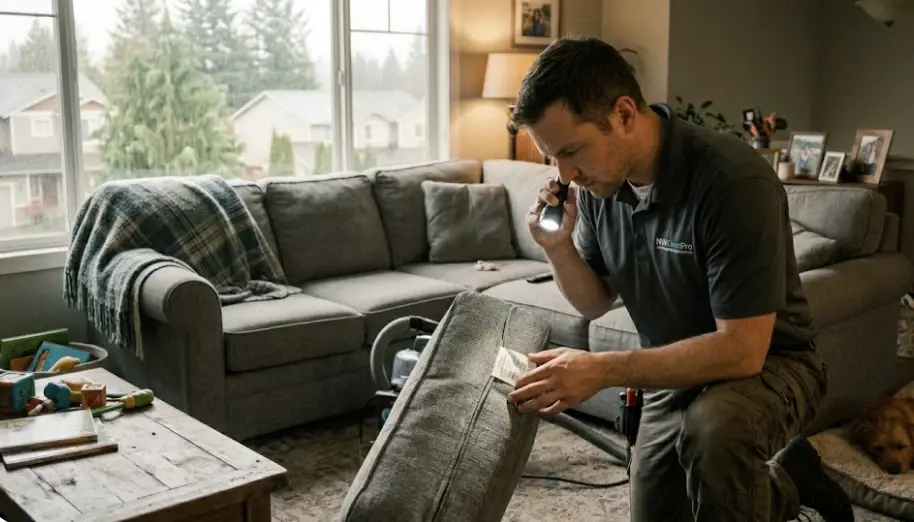
Pay attention to what happens during the initial assessment. A knowledgeable upholstery cleaner, before quoting anything, will want to know what fabric they’re dealing with. They’ll look for the cleaning code tag — the small label usually found under a cushion or on the back of the piece — and they’ll check it rather than assume. Codes matter: W means water-based cleaning is appropriate; S means solvent only and water will damage the fabric; X means vacuum only, no liquids at all. A service that quotes you a price without asking about fabric type or checking the tag hasn’t established the most basic thing they need to know before they start.
The fabric identification question goes beyond the code. Different fiber types — wool, linen, cotton, velvet, boucle, microfiber, leather, faux suede — respond differently to the same cleaning solutions and the same mechanical pressure. A competent cleaner looks at the fabric, identifies the fiber type, and adjusts their approach accordingly. If the person showing up treats every sofa the same way regardless of what it’s made of, that’s the entire problem in one sentence.
They should also ask about the history of the piece: any known stains, what products have already been used on it, whether there are pets or young children in the household, and how long since the last professional cleaning. These aren’t small-talk questions. They change the pre-treatment approach, the cleaning solution selection, and the drying time estimate. A service that skips this conversation in favor of getting straight to work is telling you something about their process.
The Carpet Cleaner Problem — and How to Spot It
There’s nothing wrong with carpet cleaning as a profession — it’s a specialized trade with its own evolving standards, and even carpet colour trends reflect how seriously homeowners take their flooring choices. But the equipment overlap between carpet and upholstery work has led a lot of carpet-first businesses to add upholstery to their service list without meaningfully changing their approach. The tell is in the questions they don’t ask and the method they default to.
Hot water extraction — the standard method for synthetic broadloom carpet — is not automatically appropriate for upholstery. On carpet, the backing and padding absorb excess moisture and the large surface area dries relatively quickly. On a sofa cushion, the fabric sits directly over dense foam that holds moisture much longer than carpet padding, and the closed structure of cushion construction means drying from the inside out is slow even with fans running. A service that applies the same moisture volume to a sofa that they’d use on carpet will often leave cushions that feel dry on the surface but remain damp in the foam core for 36 to 48 hours — long enough for mildew to establish itself.
The specific question to ask: “What method do you use, and why is it appropriate for my fabric?” A carpet cleaner who has genuinely crossed over into upholstery work will answer this specifically and explain why their chosen approach fits your piece. One who hasn’t will give a vague answer about steam cleaning being effective on everything, which is not accurate and signals that the distinction isn’t one they’ve thought carefully about.
A second marker is how they handle the drying question unprompted. Do they tell you to open windows and run fans after they leave? Do they set up their own air movement equipment? Or do they pack up and say “it’ll be dry in a couple hours” without specifying anything? In a Lynnwood home in fall or winter — when ambient humidity runs high and windows stay closed — “a couple of hours” for a freshly cleaned sofa isn’t realistic, and a service that doesn’t mention this hasn’t accounted for the local climate in their process.
What IICRC Certification Actually Means for Upholstery
The Institute of Inspection, Cleaning and Restoration Certification — IICRC — offers a specific credential for upholstery and fabric cleaning: the UFT (Upholstery and Fabric Cleaning Technician) certification. It’s not the only signal of competence, and passing the certification exam doesn’t automatically make someone skilled. But it does mean they’ve formally studied fiber identification, cleaning chemistry, stain removal science, and fabric-specific methods — which is a meaningful baseline.
The IICRC also offers the CCT (Carpet Cleaning Technician) certification separately. A company or technician with only the CCT and no UFT has been trained specifically in carpet, not upholstery. This isn’t disqualifying — field experience matters more than credentials in most service trades — but it’s useful information. Ask directly: “Are your technicians IICRC-certified for upholstery, specifically?” The answer tells you whether the training background matches the service you’re purchasing.
For Lynnwood homeowners, the IICRC website maintains a search tool that shows certified businesses by zip code — it’s worth checking before making a decision, particularly if you’re dealing with a valuable or delicate piece like leather, silk, or an antique fabric.
Stain Treatment — Where the Real Skill Gap Shows
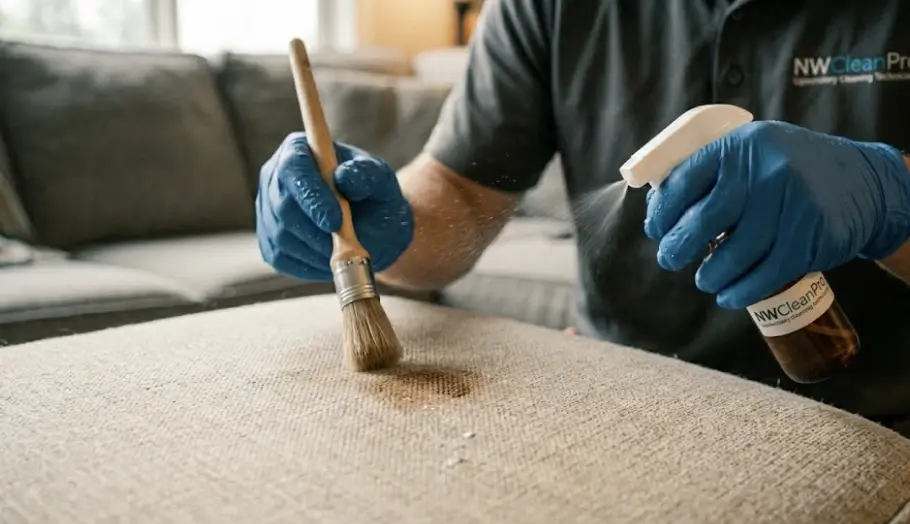
Pre-treatment of stains is where the gap between experienced upholstery specialists and carpet cleaners applying broad methods tends to be most visible in outcomes. The chemistry of stain removal is not uniform. Protein stains — pet urine, blood, food — require enzymatic solutions that break down the protein molecule structure. Apply hot water or heat to an untreated protein stain and you denature the proteins, bonding them to the fiber in a way that becomes very difficult to reverse. This is a common mistake, and it produces permanent set stains that weren’t permanent before the cleaning attempt.
Tannin stains from coffee, tea, and wine respond to different chemistry than protein stains — and so do dye-based stains, which many homeowners first encounter when dealing with food coloring stains on fabrics. Grease and oil-based soiling requires a solvent approach. Synthetic dye transfer from other fabrics or clothing is a different problem again. A service that uses one pre-treatment product on all stain types is not actually doing stain treatment — they’re applying a product and hoping.
Ask the technician, before they start, what they’re applying to each stain and why. A skilled cleaner will answer without hesitation and explain the chemistry in plain terms. Someone who doesn’t know why they’re using a particular product will give a vague answer or deflect. The question itself isn’t a test of knowledge — it’s a prompt that surfaces whether knowledge is present.
What the Price Range Tells You — and What It Doesn’t
Upholstery cleaning in the Lynnwood and greater Seattle metro market runs roughly $80 to $150 for a standard sofa, depending on fabric type, size, and condition. Add $40 to $80 for a matching loveseat, $25 to $50 per chair. Pet odor treatment is typically priced separately and adds $40 to $100 depending on severity and area affected. These are realistic ranges for quality work from an established service — not a bargain basement price and not a premium luxury service number either.
Prices significantly below this range — $49 for a sofa plus loveseat is the most common bait pricing you’ll see — almost always reflect one of two things: a volume operation that moves through homes fast with minimal attention to fabric-specific detail, or a pricing structure where the initial quote is designed to get them in the door before additional charges appear. Neither is necessarily catastrophic for a basic polyester sofa in good condition, but neither is appropriate for anything delicate, expensive, or already problematic.
Prices significantly above market, on the other hand, don’t automatically indicate better work. The Seattle metro premium service market includes some genuinely excellent operators and some who’ve priced to the neighborhood rather than to their actual skill level. Price is a rough filter, not a guarantee. The questions you ask before they start are a better signal than the number on the invoice.
The Local Specifics — Lynnwood Fabric Realities in a PNW Climate
Lynnwood homeowners dealing with upholstery care have a few specific variables that a service familiar with the local market should know without prompting. The extended damp season — roughly October through April — means post-cleaning drying is always a more active concern than it would be in a drier climate. A good local service accounts for this. They bring fans, they’re explicit about ventilation requirements, and they err on the side of using less moisture rather than more because they’ve seen what over-wetting does in a western Washington home in November.
Pet ownership rates in Snohomish County are high by national standards — Washington state consistently places in the top quartile for pet households. Services that work primarily in this market should have strong enzymatic pet treatment protocols and be direct about what they can and can’t remove rather than promising outcomes they can’t guarantee. Urine that has reached the foam is a different problem than urine on the fabric surface, and the treatment required is different. A cleaner who doesn’t make this distinction before starting is setting you up for disappointment.
The fabric trends in higher-end Lynnwood homes in the past three to five years have skewed toward boucle, textured weaves, and performance fabrics marketed as stain-resistant. Performance fabrics — many of which use a tight synthetic weave with a fluorocarbon coating — do have better initial stain resistance, but the coating degrades over time and requires specific reapplication after professional cleaning. A service that cleans a performance fabric without mentioning this hasn’t told you something relevant to why you paid for the fabric in the first place.
When you’re looking for a genuinely quality upholstery cleaner in Lynnwood WA, the filter that actually works isn’t checking Google reviews for five stars — it’s the conversation before the work starts. How they respond to specific questions about your fabric type, your stains, and their drying process tells you more about their skill level than any badge or rating system. A technician who gives specific answers and adjusts their approach to what’s in front of them is the one you want in your house.
After the Cleaning — What Good Service Looks Like at the End
A few things should happen at the end of a quality upholstery cleaning appointment that are easy to miss in the moment but worth paying attention to.
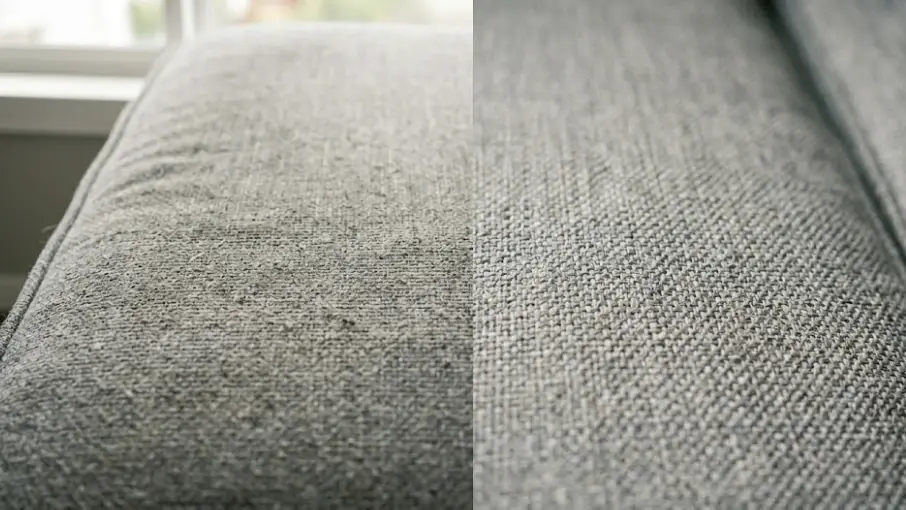
The technician should walk you through the results on specific spots that were treated — not to brag, but to set realistic expectations about what fully resolved and what may need a follow-up or simply can’t be completely removed (set stains, permanent dye transfer, and heavily oxidized soiling have limits regardless of method). Honest assessment of what cleaned well and what didn’t is a mark of professionalism, not a failure to deliver.
They should give you specific drying guidance: how long to keep pets and kids off the furniture, whether you should run fans, and what to do if you notice any spots resurface after drying (a phenomenon called wicking, where soil trapped deep in the fiber migrates back to the surface as moisture evaporates). Wicking doesn’t mean the cleaning failed — it means the stain had penetrated deeper than the surface — but knowing it might happen and how to address it is the kind of information a knowledgeable service provides.
Finally, they should tell you what they used. Not a full chemistry lecture, but the product category: enzymatic for the pet areas, tannin treatment for the coffee stain, hot water extraction or low-moisture method for the field. This matters because if you have a reaction to a cleaning product, or if you want to know what to use for spot cleaning between professional sessions, you need to know what’s already on the fabric. A service that leaves without answering this question hasn’t finished the job.