


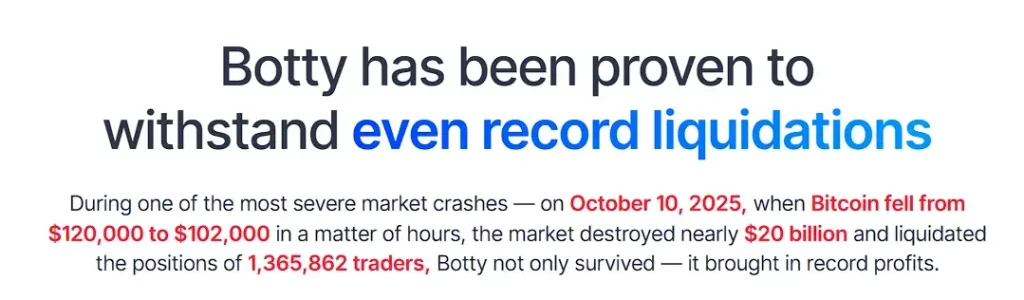
October 10, 2025 will be remembered as one of the most turbulent days in recent crypto history. In the span of a single hour, the market shed billions. Bitcoin fell from $120,000 to $102,000. Ethereum and Solana followed. Within 24 hours, roughly $20 billion in leveraged positions had been wiped out across exchanges globally. For the vast majority of market participants, it was a day of shock, panic, and significant financial loss.
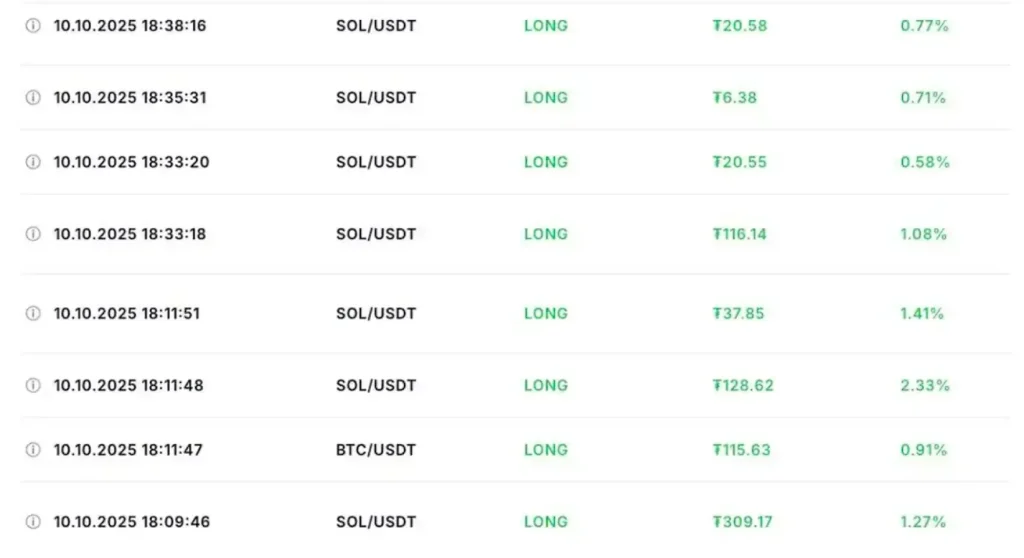
Yet for users of Botty — an automated cryptocurrency trading platform — the day told a very different story. While over 1.3 million traders saw their positions liquidated, Botty’s algorithms continued executing trades calmly and systematically, ultimately generating $23,896 in profits across BTC, ETH, and SOL bots on that single day. Not a single position was liquidated.
This article examines what happened on October 10, 2025, why the outcome was so different for algorithmic vs. manual traders, and what this event reveals about the architecture and risk philosophy behind Botty.
Key Takeaways
- On October 10, 2025, Bitcoin dropped from $120,000 to $102,000 within hours.
- Over $7 billion in positions were liquidated in a single hour — a record figure at the time.
- Total liquidations across the market reached approximately $20 billion within 24 hours.
- 1,365,862 individual traders lost their positions on that day.
- Botty’s bots running on BTC, ETH, and SOL not only avoided liquidation — they earned $23,896 in verified, on-exchange profits.
- All results were generated automatically, without manual intervention, using pre-configured grid and averaging strategies.
- The event demonstrates how algorithmic discipline responds differently to volatility compared to emotionally driven manual trading.
October 10, 2025: When the Crypto Market Collapsed
The crypto market had been operating at elevated price levels for several months leading up to October 2025. Bitcoin had climbed steadily through the year, reaching a peak above $120,000. Sentiment was broadly optimistic, and a significant share of open interest across exchanges consisted of leveraged long positions — bets that the market would continue rising.
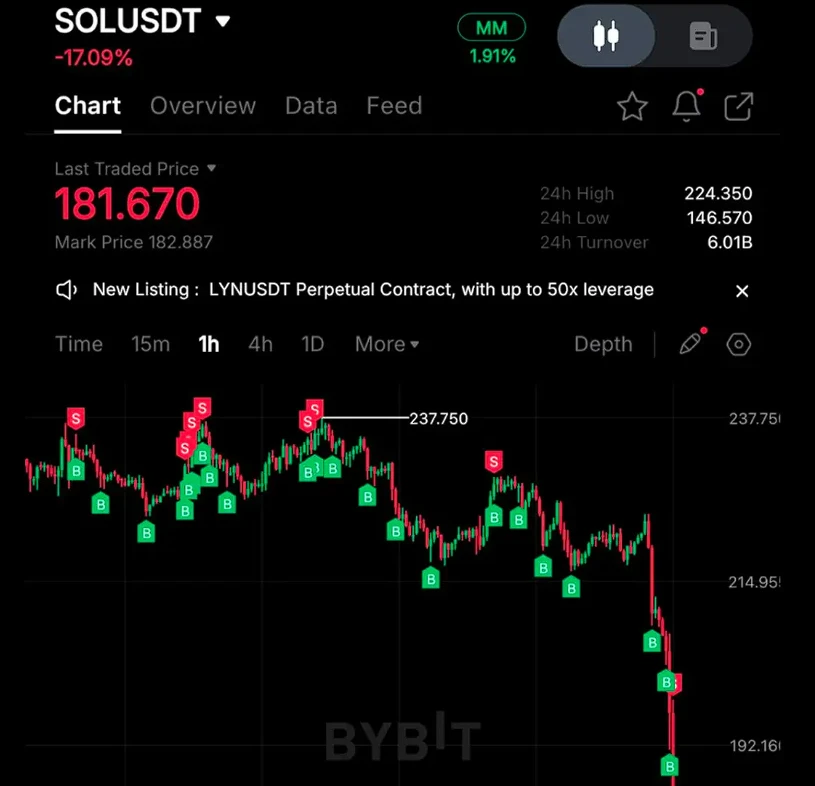
When the correction came, it was sudden and severe. Bitcoin dropped nearly 15% within hours. Altcoins, which tend to amplify Bitcoin’s movements, fell even harder. Ethereum and Solana registered double-digit percentage declines within the same window.
For traders holding leveraged futures positions — particularly those using high leverage ratios without adequate capital reserves — the cascade was catastrophic. Liquidation engines on major exchanges triggered automatically as prices pierced through margin thresholds. One position after another was forcibly closed at a loss. The volume of liquidations was staggering even by historical standards: $7 billion within 60 minutes is a figure that dwarfs most single-day liquidation events from previous market cycles.
What made the situation especially painful for many traders was not just the scale of losses, but the speed. Manual intervention was nearly impossible. By the time individuals saw the movement, reacted emotionally, and attempted to adjust their positions, much of the damage had already been done.
Why So Many Traders Were Caught Off Guard
Market crashes of this magnitude expose the structural weaknesses of manual, emotion-driven trading. Several factors converged to create the conditions for widespread liquidations on October 10.
First, overconfidence in a trending market. During extended bull runs, traders tend to increase their exposure and reduce their caution. Risk management rules that are sensible in a neutral market get quietly abandoned when everything is going up. Leverage levels creep higher. Safety buffers shrink.
Second, the absence of 24/7 vigilance. The crypto market never closes. Price swings can hit at any hour, including the middle of the night in any timezone. A trader sleeping in Europe when a correction starts in an Asian session may wake to an already-liquidated account. Human beings simply cannot maintain constant attention to a market that never rests.

Third, the psychology of falling markets. When prices begin to drop sharply, two dominant emotions take over: fear and the desire to recoup losses. Fear causes traders to freeze or exit at the worst possible moment, locking in losses. The desire to recover leads others to add exposure into a declining market without adequate structure — a move that can accelerate losses rather than reduce them.
Fourth, insufficient reserve capital. Many traders deploy the majority of their available funds into active positions, leaving little buffer to withstand drawdowns. When prices fall and margin requirements tighten, there is nothing left to add. Liquidation becomes inevitable.
These are not new problems. They are well-documented patterns in market psychology and risk management literature. What October 10, 2025 demonstrated was how quickly they can manifest at scale.

What Botty’s Algorithms Did That Day
While the human side of the market was unraveling, Botty’s bots were doing precisely what they were configured to do: executing their grid strategies methodically, buying into the decline, averaging down positions, and capturing profit on every upward bounce — however small.
The result was $23,896 in profits across BTC, ETH, and SOL — verified through on-exchange trade history. Every entry and exit was executed automatically. Not a single trade required manual input from the Botty team. The timestamps on the trade records correspond exactly to the period of maximum market volatility.
The founders of Botty noted at the time: “Our bots, running on BTC, ETH and Solana, didn’t just avoid liquidation — they earned on this movement. This is exactly why we’re building Botty. So that people who don’t want to live under constant stress have a technology that can trade with a clear head, by algorithm, without emotions.”
It is worth being precise here: Botty does not guarantee that results like these will repeat under similar conditions. Past performance is not indicative of future results, and market conditions in any future crash will differ. What the event does demonstrate is that the underlying strategy — grid-based accumulation with logarithmic order distribution — is structurally suited to high-volatility environments where price moves significantly and then partially retraces.
The Logic Behind the Strategy
To understand why Botty’s approach performed the way it did on October 10, it helps to understand the core mechanics of how the platform’s algorithms work.
Botty’s bots do not attempt to predict market direction. They do not use technical analysis to identify entry points, and they do not rely on news flow or sentiment signals. Instead, they operate on a mathematical structure: a grid of orders spread across a defined price range.
When the market moves down, the bot systematically opens additional positions at lower price levels, effectively averaging the cost of entry. Each order is sized according to a logarithmic distribution — larger orders near current prices, smaller orders further away — calculated to ensure the average entry price remains within a range that can generate profit on a modest recovery.
When the market bounces, even slightly, the bot identifies the opportunity to close the accumulated position at a net gain. This is not a large gain per trade — Botty’s templates typically target a profit of around 0.8% per close. But across hundreds of trades in a single day of heavy volatility, small margins compound into meaningful figures.
The analogy the Botty team uses is instructive: imagine buying one kilogram of something at 30 units of currency. The price drops to 20. Instead of waiting for it to return to 30 to break even, you buy two more kilograms at 20. Your average cost is now approximately 23. When the price recovers to 24, you sell all three kilograms and take a profit. You didn’t need the price to return to where it started. A modest recovery was sufficient.
On a day like October 10, this mechanic finds its natural environment. The sharp drop creates the conditions for deep accumulation. The partial recoveries — the brief upward moves that inevitably occur within any large sell-off — trigger profitable closes. The algorithm repeats this cycle continuously, capturing each bounce without waiting for a full market recovery.
Algorithmic Discipline vs Human Emotion
Perhaps the most significant takeaway from October 10, 2025 is not the specific profit figure, but what it illustrates about the difference between algorithmic execution and human decision-making under pressure.
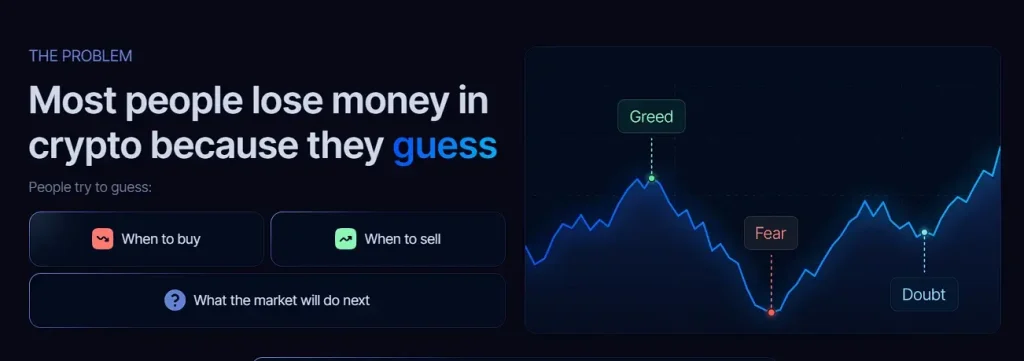
A human trader watching Bitcoin fall $18,000 in a few hours experiences a physiological stress response. Cortisol levels rise. Decision-making quality degrades. The inclination to act — to do something, anything — becomes difficult to resist, even when the correct move is to wait. Many of the 1.3 million liquidations that occurred on October 10 were likely accompanied by frantic, emotional responses that made outcomes worse rather than better.
An algorithm experiences none of this. It has no anxiety about the falling price. It does not consider what other traders are doing. It does not check social media for reassurance or panic. It simply executes the next instruction in its queue: place the next order at the next price level, according to the parameters it was given.
This is not a new observation. Behavioral finance has documented the costs of emotional decision-making in markets for decades. What makes automated trading platforms like Botty relevant is that they offer an accessible way to remove the emotional variable from the equation — not just for professional traders, but for anyone willing to understand how the algorithms work and deploy them appropriately.
Botty does not position itself as a replacement for market understanding. The platform’s onboarding process is deliberately educational. Users are required to review materials explaining how the strategies function, acknowledge the risks involved, and confirm they understand why a bot might temporarily show an unrealized loss while accumulating a position. The goal is not passive delegation of responsibility, but informed deployment of a structured tool.

How the Non-Custodial Model Held Up Under Pressure
One aspect of October 10 that deserves attention is how the platform’s security model performed during extreme market conditions. Botty operates on a non-custodial basis: user funds are never held by the platform itself. All assets remain on the user’s exchange account at all times.
Botty connects to exchange accounts via API keys configured with trade-only permissions. The platform can open and close positions according to the bot’s parameters, but it cannot withdraw funds, transfer balances, or take any action outside the scope of trading. This architecture means that even in a scenario where the Botty platform itself experienced a technical issue, user funds would remain safely on their exchange accounts.
During October 10, with exchanges processing unusually high volumes and some platforms reporting latency or temporary outages, this model proved its value. The separation between the trading logic and the custody of funds meant that users retained full control at all times, regardless of what was happening at the infrastructure level.
This is a structural distinction from platforms that hold user deposits centrally or require funds to be transferred into a proprietary wallet before trading can begin. In a high-stress market event, the question of where your funds actually are becomes more than theoretical.
What This Reveals About Risk Management
The performance on October 10 was not accidental. It was the product of deliberate risk management decisions built into Botty’s template architecture.
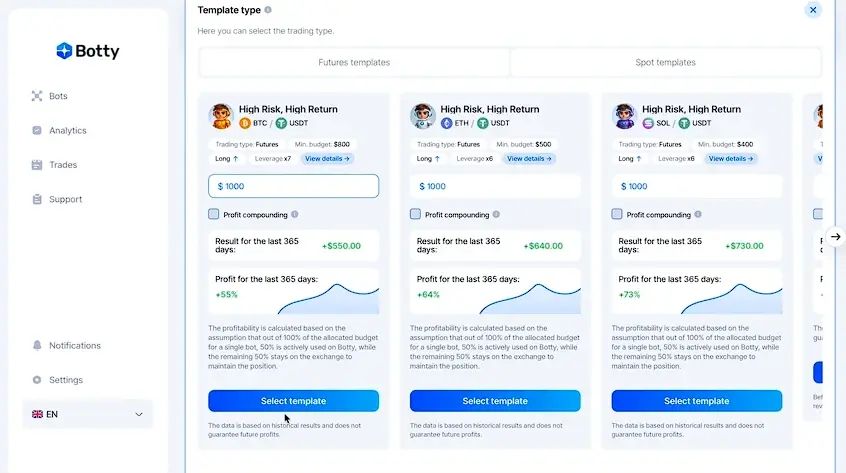
The platform limits maximum leverage at 10x across its futures templates. While this is lower than the leverage many traders use independently, it provides meaningful protection against the kind of rapid liquidation cascade that affected markets on October 10. Botty’s documentation is explicit that liquidation risk cannot be fully eliminated in futures trading — but it can be structurally managed.
The recommended capital allocation model — deploying no more than 50% of available funds into active bot positions, with the remaining 50% held as a reserve on the same exchange account — serves a specific purpose. This reserve allows the bot’s liquidation point to be pushed further from current prices, providing additional buffer against extreme moves. In practical terms, for BTC futures with standard template settings, this architecture places the liquidation threshold at a level that, based on historical data, has never been reached without a significant upward correction occurring first.
Botty’s templates are also calibrated exclusively to what the team refers to as fundamental assets: Bitcoin, Ethereum, and Solana. These are the most liquid, most widely traded cryptocurrencies, with the deepest order books and the most predictable correction behavior. The decision not to offer templates for smaller-cap altcoins, which can experience far more severe and prolonged drawdowns, reflects a conservative approach to risk that prioritizes capital preservation over maximum theoretical return.
The founders describe the philosophy directly: the strategy is designed for long-term operation, not short-term speculation. Templates are backtested across multiple years of historical market data, including bear cycles, to verify that the underlying logic holds across different market phases — not just during favorable conditions.

Is Algorithmic Trading the Answer for Volatile Markets?
October 10, 2025 invites a broader question: does the performance of Botty’s algorithms on that day suggest that algorithmic trading is a reliable solution for navigating volatile crypto markets?
The honest answer requires nuance. Algorithmic trading is not a guarantee of positive outcomes. Markets can behave in ways that no historical backtest has accounted for. An extended one-directional move without any meaningful recovery — a scenario sometimes called a “flash crash to zero” in theoretical discussions — would stress even well-structured grid strategies. The platform’s own documentation is clear: past performance does not guarantee future results.
What October 10 does demonstrate is that a structured, rule-based approach to trading can respond to volatility in ways that human-driven approaches often cannot. The algorithm did not panic. It did not abandon its parameters. It did not freeze at the worst possible moment. It simply executed its logic — and that logic happened to be well-suited to exactly the kind of market behavior that day produced.
There is also a practical argument for automation that goes beyond any single market event. The crypto market operates every hour of every day. No individual can monitor it continuously while also sleeping, working, and living a normal life. Automation does not solve every problem in trading, but it does address one of the most fundamental constraints: time. A bot running at 3am on a Sunday captures the same opportunities as one running at noon on a Tuesday. Human traders cannot say the same.
Botty’s founders have been direct about what the platform is and is not. It is not a “money button” that generates passive income without any user engagement or understanding. It is not an AI system that makes independent market predictions. It is an automation tool: a mechanism for executing a pre-defined strategy consistently, without the interference of emotion, fatigue, or distraction. October 10, 2025 was a stress test that showed what that consistency looks like in practice.

Botty’s Track Record Beyond October 2025
The October 10 event is striking precisely because of its scale, but it is not the only data point in Botty’s operational history. The platform’s algorithms have been running continuously for more than three years in live market conditions, generating over $1.5 billion in peak monthly trading volume across exchanges.
The strategies underlying Botty’s templates were developed and refined over years of real-money trading by the platform’s founders, whose background includes building one of the largest crypto education communities in Eastern Europe. More than 30,000 students worked with the same algorithmic approaches that now power Botty’s templates, providing a large base of real-world performance data across different market conditions.
The platform’s templates include strategies designed for different market phases: bull market conditions, all-season configurations that prioritize stability over maximum return, and templates suited to more defensive postures during uncertain periods. The founders advise that seasonal templates — those optimized for specific market phases — should be used by traders who have sufficient market understanding to recognize when conditions are shifting. All-season templates, while historically offering lower potential returns, are designed for users who prefer a more stable, lower-maintenance approach.
The performance fee model that Botty uses — charging only when a trade closes profitably, with no fixed monthly subscription — is aligned with this philosophy. If the bot is not generating closed profitable trades, the platform does not earn. This creates a structural incentive for the platform’s templates to be built around genuine long-term performance rather than short-term statistics that look impressive on a presentation slide.