


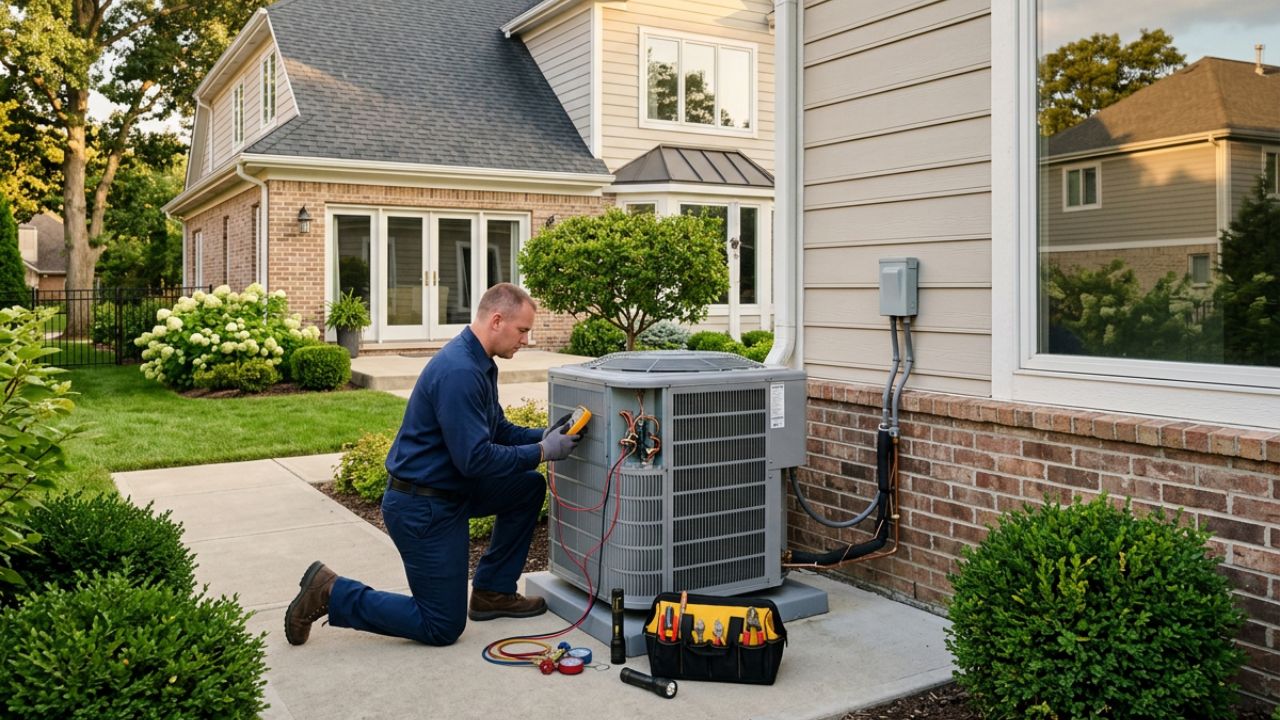
The Core Pillars of Digital Marketing and Search Visibility
Search visibility is not one tactic. It is an ecosystem of assets, signals, content, and conversion paths that work together to help an HVAC company appear when a homeowner needs service, replacement, maintenance, or emergency support.
For HVAC contractors in Dallas-Fort Worth, the best HVAC marketing strategies usually combine five core pillars:
- Local SEO — ranking in Google Maps, local organic results, and “near me” searches.
- Organic search content — answering homeowner questions before competitors do.
- Technical optimization — ensuring search engines and users can access the site quickly and easily.
- Paid lead generation — using Google Ads, Local Services Ads, and social campaigns for immediate demand.
- Conversion and reputation systems — turning traffic into calls, appointments, reviews, and repeat customers.
In a market as competitive as DFW, contractors cannot rely on a website alone. A beautiful site with no local authority will not generate enough leads. A strong Google Business Profile with a slow website may lose customers before they call. Paid ads without tracking may create activity but not profit.
The goal is to build a complete digital presence that helps the business show up, stand out, and convert.
For HVAC companies, this is especially important because customer intent changes quickly. Someone searching “AC repair near me” during a Texas heat wave is not browsing casually. They are often ready to call immediately. Someone searching “how long does an HVAC system last” may be months away from replacement but still valuable if your brand becomes the trusted source early.
Strong HVAC marketing meets both types of demand: urgent service calls and long-term customer education.
Building Topical Authority to Dominate Online Search
Search engines increasingly reward companies that demonstrate depth, relevance, and expertise across a topic. For HVAC contractors, that means publishing more than a few generic service pages.
A strong content strategy should create a topical map around the services, locations, problems, and customer questions that matter most. This usually includes:
- AC repair pages
- Furnace repair pages
- Heat pump service pages
- Indoor air quality pages
- Maintenance plan pages
- Emergency HVAC pages
- Installation and replacement pages
- Service-area pages for individual DFW cities and neighborhoods
- Blog content that answers homeowner questions
- Seasonal guides for cooling, heating, tune-ups, and energy efficiency
This structure helps search engines understand that the company is not just mentioning HVAC services; it is a credible source across the entire customer journey.
For example, an HVAC contractor serving Dallas, Fort Worth, Arlington, Plano, Frisco, Irving, and Denton should not rely on one generic “service area” page. Each major city or suburb deserves a useful, locally relevant page that reflects the actual services offered there. That does not mean copying the same page and changing the city name. It means creating pages with unique content, local references, service details, FAQs, testimonials when available, and clear calls to action.
Content clustering is one of the most effective ways to build this authority. A pillar page may cover “HVAC repair in Dallas-Fort Worth,” while supporting articles answer more specific questions such as:
- Why is my AC blowing warm air?
- How often should I schedule HVAC maintenance in North Texas?
- Should I repair or replace my air conditioner?
- What are signs my furnace needs service?
- How can homeowners reduce cooling costs in summer?
When these pages are internally linked and organized clearly, they help both users and search engines navigate the site. Contractors that want to understand how to structure this kind of visibility strategy can use resources that explain how to Dominate online search with a broader HVAC marketing framework.
Topical authority also supports new search behaviors. In June 2026, homeowners are not only using traditional Google searches. They may ask AI assistants, voice search tools, or map apps for recommendations. Content that is clear, well-structured, and helpful is more likely to be surfaced across these environments.
The strongest HVAC content is practical rather than promotional. Homeowners want direct answers:
- What does this problem mean?
- Is it urgent?
- Can I troubleshoot it safely?
- When should I call a professional?
- What should I expect during the appointment?
If your website answers these questions better than competitors, it becomes more than a brochure. It becomes a digital sales assistant.
Technical SEO and Digital Marketing and Search Visibility
Technical SEO is the foundation that allows your content, local SEO, and paid campaigns to perform properly. Even the best content can struggle if the website is slow, poorly organized, difficult to crawl, or frustrating on mobile devices.
For HVAC companies, technical optimization should focus on the practical factors that affect both rankings and conversions:
- Fast page load speed
- Mobile-first design
- Clear navigation
- Secure HTTPS configuration
- Clean URL structure
- Schema markup
- Accessible forms and phone numbers
- Proper indexing
- Optimized images
- Reliable hosting
- No broken links or duplicate pages
Mobile performance deserves special attention. Many HVAC searches happen from smartphones, often when the customer is dealing with a stressful home comfort issue. If the site takes too long to load or the phone number is hard to tap, that lead may go to another contractor.
Technical SEO also includes structured data, often called schema markup. Schema helps search engines understand key business information, such as:
- Business name
- Service area
- Hours
- Reviews
- Services offered
- FAQs
- Location details
- Contact information
For HVAC contractors, LocalBusiness schema, HVACBusiness schema where appropriate, FAQ schema, review markup, and service schema can all help search engines interpret your pages more accurately.
Technical optimization also supports paid campaigns. If Google Ads or Local Services Ads send visitors to a slow, confusing, or generic landing page, the campaign will likely underperform. A high-quality landing page should match the user’s intent. Emergency repair ads should send users to a page focused on fast help, phone calls, trust signals, and availability. Replacement ads should send users to a page with financing information, equipment options, warranties, reviews, and consultation prompts.
Modern web development platforms, including low-code and visual development tools, can help contractors maintain faster, cleaner websites when implemented correctly. However, the platform matters less than execution. A site should be built for performance, search visibility, accessibility, and lead generation from the beginning.
Maximizing Local Search and Lead Generation
For HVAC companies, local search is often the most important battleground. Homeowners are rarely looking for a contractor across the country. They want someone nearby, trustworthy, available, and well-reviewed.
That makes Google Business Profile one of the most valuable marketing assets an HVAC company can own.
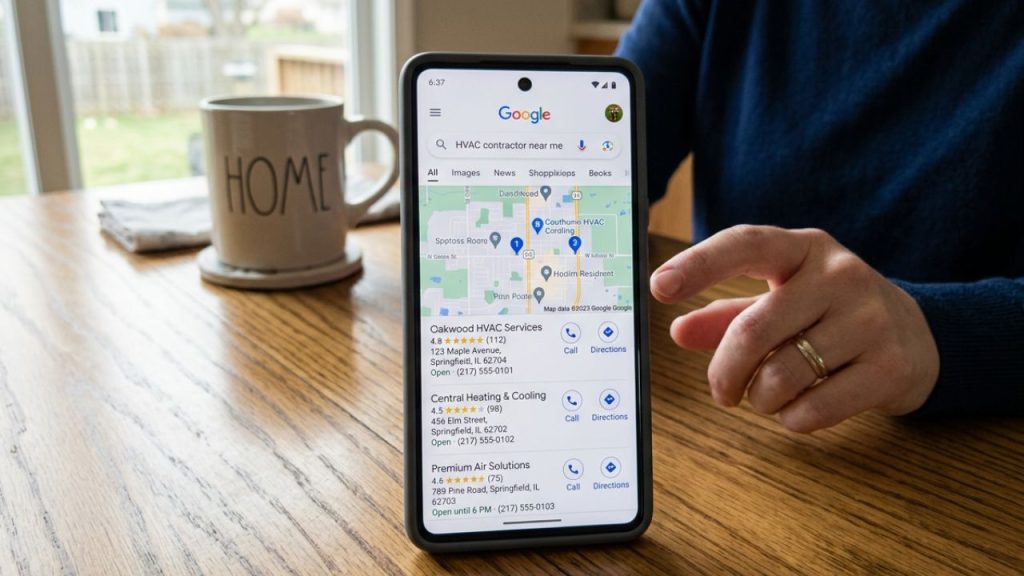
A fully optimized Google Business Profile should include:
- Accurate business name, address, and phone number
- Correct service categories
- Complete service areas
- Business hours and special hours
- High-quality photos
- Service descriptions
- Appointment links
- Messaging options if actively monitored
- Regular posts
- Review responses
- Products or services where appropriate
- Q&A content
For DFW contractors, service-area accuracy is especially important. Dallas-Fort Worth is a large metroplex with many distinct cities and suburbs. A contractor serving Fort Worth, Keller, Southlake, Grapevine, and North Richland Hills may need a different local visibility strategy than one focused on Dallas, Richardson, Garland, Mesquite, and Plano.
Local SEO is built on consistency. Your business information should match across major directories, review platforms, social profiles, data aggregators, and industry sites. This is often called NAP consistency: name, address, and phone number.
Inconsistent listings create confusion for search engines and customers. If one directory shows an old phone number and another shows a former address, local trust signals weaken. Regular citation audits help prevent these issues.
Review velocity is another major factor. Total review count matters, but recent, consistent reviews often carry more practical value. A company with a steady stream of new reviews appears active and trusted. A company with many old reviews but little recent activity may look less relevant.
Effective review generation should be ethical, simple, and consistent:
- Ask after every completed job.
- Send a direct review link by text or email.
- Train technicians to explain why reviews help local businesses.
- Respond to every review professionally.
- Never buy, fake, or pressure customers for reviews.
- Use negative feedback as an opportunity to demonstrate responsiveness.
The best HVAC marketing agencies for contractors in Dallas-Fort Worth understand that local search is not just about rankings. It is about winning trust at the moment of decision. A map listing with recent reviews, strong photos, accurate hours, and a clear service area can produce high-intent leads without requiring the customer to visit multiple pages.
Local SEO also helps HVAC companies compete against larger brands. A national or private-equity-backed company may have a bigger ad budget, but a well-optimized local contractor can still win through neighborhood relevance, authentic reviews, and faster response.
Paid Acquisition Strategies for Digital Marketing and Search Visibility
Paid advertising gives HVAC companies speed. SEO builds long-term visibility, but paid campaigns can create lead flow quickly when managed carefully.
The strongest paid strategies usually combine several channels based on intent:
- Google Local Services Ads for high-intent local calls
- Google Search Ads for emergency repair, replacement, and service keywords
- Remarketing ads for users who visited the website but did not convert
- Facebook and Instagram ads for awareness, maintenance offers, financing messages, and seasonal campaigns
- YouTube or video ads for brand trust and education
- Display campaigns for retargeting and local visibility
Google Local Services Ads often sit at the top of search results and can be effective because they are tied closely to service categories, location, reviews, and trust indicators. For HVAC companies in Dallas-Fort Worth, lead costs through this channel can vary depending on season, competition, service type, and response quality. Since pricing changes frequently, contractors should avoid judging performance by lead cost alone. A more useful metric is cost per booked job and, ultimately, revenue generated from those booked jobs.
Google Search Ads work best when campaigns are separated by intent. Emergency repair, system replacement, maintenance, and brand campaigns should not be lumped together. Each has different keywords, landing pages, urgency levels, and conversion expectations.
For example:
- Emergency repair campaigns should emphasize speed, availability, trust, and phone calls.
- Replacement campaigns should emphasize expertise, comfort, warranties, financing options, and consultation.
- Maintenance campaigns should focus on prevention, savings, seasonal readiness, and membership value.
- Brand campaigns should protect your company name from competitors bidding on it.
Search intent matters because HVAC customers behave differently depending on the problem. A homeowner with no cooling in July may call the first credible company that answers. A homeowner considering a system replacement may compare several contractors, read reviews, check financing options, and revisit the site multiple times.
Facebook and Instagram ads can also be valuable, especially for:
- Seasonal tune-up reminders
- Maintenance plan promotions
- Indoor air quality education
- Retargeting website visitors
- Before-and-after visuals
- Community involvement
- Customer testimonial videos
One of the most overlooked factors in paid advertising is speed to lead. If a contractor pays for a high-intent lead but responds slowly, the marketing investment is wasted. HVAC companies should have systems in place to answer calls, follow up on missed calls, send automated texts, and track whether inquiries turn into booked appointments.
A professional HVAC marketing agency should report beyond clicks and impressions. Useful reporting includes:
- Calls by channel
- Form submissions by channel
- Booked jobs by channel
- Cost per booked job
- Revenue attribution where available
- Call answer rate
- Booking rate
- Missed call recovery
- Landing page conversion rate
- Review growth
- Organic ranking trends
This is where HVAC-specific agencies often outperform general marketing firms. A general agency may understand ads, but an HVAC-focused team is more likely to understand seasonality, emergency intent, service-area targeting, technician capacity, replacement economics, and the importance of call handling.
Leveraging AI and Modern Web Development for Growth
AI is changing how customers discover, compare, and choose service providers. Search visibility now extends beyond traditional blue links and map results. Homeowners may use AI-generated answers, voice assistants, smart devices, and conversational search tools to find HVAC information.
That shift has created new disciplines such as Generative Engine Optimization, or GEO, and Answer Engine Optimization, or AEO.
While traditional SEO focuses on ranking pages in search results, GEO and AEO focus on making content easier for AI systems and answer engines to interpret, summarize, and recommend.
This does not mean abandoning SEO fundamentals. In fact, AI visibility usually depends on strong fundamentals:
- Clear, expert content
- Structured headings
- Concise answers
- Schema markup
- Authoritative service pages
- Consistent business information
- Review signals
- Fast website performance
- Local relevance
- Helpful FAQs
HVAC companies can improve AI search visibility by writing in a way that directly answers common questions. For example, instead of publishing a vague article titled “HVAC Tips,” a contractor could create focused pages such as:
- “Why Is My AC Running but Not Cooling?”
- “How Often Should I Replace My Air Filter in North Texas?”
- “What Size HVAC System Does My Home Need?”
- “Is a Heat Pump a Good Option in Dallas-Fort Worth?”
- “When Should I Replace Instead of Repair My AC?”
Each page should answer the question clearly near the top, then provide supporting details, safety notes, and a call to action when professional service is needed.
Modern web development also plays a role in growth. Contractors need websites that are flexible enough to support landing pages, content hubs, local pages, analytics, call tracking, forms, chat tools, and CRM integrations.
A high-performing HVAC website should include:
- Service pages for every core offering
- Location pages for important service areas
- Strong calls to action
- Click-to-call functionality
- Online scheduling or request forms
- Testimonials and reviews
- Financing or maintenance plan information
- Trust badges and certifications
- Fast load times
- Accessibility best practices
- Analytics and conversion tracking
AI can also support operations. Chat tools, automated follow-up, review request workflows, and CRM integrations can reduce missed opportunities. However, automation should not replace human service. HVAC is still a trust-driven business. AI is most effective when it helps the team respond faster, organize leads, and personalize communication.
Email marketing remains one of the most reliable long-term growth tools. Once a customer has used your company, the relationship should not go dormant. Email can support:
- Seasonal tune-up reminders
- Filter replacement reminders
- Maintenance agreement renewals
- Dormant customer reactivation
- Replacement education
- Indoor air quality promotions
- Weather-triggered campaigns
- Review requests
- Referral campaigns
Reputation management and email marketing work together. A happy customer who receives timely follow-up is more likely to return, review, and refer. Retention is especially important because HVAC customers can become highly valuable over time through maintenance, repairs, replacements, and referrals.
Frequently Asked Questions about Search Visibility
How long does it take to see results from search visibility strategies?
Search visibility results depend on the channel.
Paid ads can generate leads quickly once campaigns, targeting, tracking, and landing pages are properly configured. Google Business Profile improvements may start influencing local visibility within weeks, especially when paired with new photos, reviews, posts, and accurate service information.
SEO typically takes longer. Most HVAC companies should think in terms of months, not days. New websites, competitive markets, weak content, poor technical structure, or limited review activity can extend the timeline. Established companies with strong domains and existing content may see faster gains after optimization.
A realistic search visibility process usually includes three phases:
- Foundation phase — technical cleanup, tracking, keyword research, local SEO setup, and website improvements.
- Growth phase — publishing content, building service-area pages, improving reviews, and optimizing campaigns.
- Optimization phase — using performance data to refine pages, ads, calls to action, budgets, and conversion paths.
The key is consistency. SEO compounds over time when the business continues publishing helpful content, earning reviews, improving user experience, and maintaining accurate local signals.
What is the difference between standard SEO and Generative Engine Optimization (GEO)?
Standard SEO focuses on improving visibility in traditional search results, including organic listings, local map results, and search snippets. It involves keyword strategy, content creation, technical SEO, link signals, local optimization, and user experience.
Generative Engine Optimization focuses on helping AI-driven systems understand and summarize your content. These systems may generate answers rather than simply listing websites. GEO overlaps with SEO but places more emphasis on structure, clarity, topical authority, entity recognition, and direct answers.
Answer Engine Optimization is closely related. AEO focuses on making content easy to use in featured snippets, voice search responses, FAQs, and AI summaries.
For HVAC contractors, all three should work together. A page about “AC repair in Fort Worth” should be optimized for local rankings, written clearly enough for AI tools to interpret, and structured with FAQs that answer homeowner questions directly.
Good GEO practices include:
- Using plain, specific language
- Answering questions early in the page
- Adding FAQ sections
- Marking up content with schema
- Building strong service and location pages
- Demonstrating real-world expertise
- Keeping business information consistent
- Earning reviews that reinforce trust
AI search does not eliminate the need for a strong website. It raises the standard for clarity and credibility.
Why is review velocity more important than total review count?
Total review count is still important, but review velocity shows ongoing customer activity. A company with steady recent reviews appears active, trusted, and relevant. A company with many reviews from years ago but few recent ones may not inspire the same confidence.
For Google Business Profile performance, recent reviews can influence both visibility and conversion. Customers also look for current proof. If homeowners see that people are reviewing the company this month, they are more likely to believe the business is reliable now.
Review velocity also reflects operational discipline. Companies that consistently request reviews tend to have better follow-up systems, stronger customer communication, and more engaged teams.
A good review generation process should be built into daily operations:
- Ask in person after successful service.
- Send a same-day review link.
- Keep the request short and easy.
- Respond to every review.
- Share positive reviews internally with the team.
- Address negative reviews calmly and professionally.
Reviews do more than support rankings. They reduce buyer hesitation. In HVAC, trust matters because customers are inviting technicians into their homes and making decisions about comfort, safety, and significant equipment investments.
What makes an HVAC marketing agency effective for contractors in Dallas-Fort Worth?
An effective HVAC marketing agency understands both digital strategy and the realities of the HVAC business model. DFW contractors deal with extreme seasonality, high competition, urgent service demand, and diverse service areas. A good agency should know how to adjust campaigns for summer cooling demand, winter heating needs, shoulder-season maintenance, and replacement opportunities.
The most effective agencies usually provide:
- Local SEO expertise
- HVAC-specific content strategy
- Google Business Profile optimization
- Paid search and Local Services Ads management
- Landing page optimization
- Review generation systems
- Call tracking and lead attribution
- Website performance improvements
- Clear reporting tied to booked jobs
- Seasonal campaign planning
- Ongoing communication and testing
Contractors should look for proof of performance, not just broad marketing claims. Case studies, transparent reporting, HVAC client experience, and knowledge of local markets are more meaningful than generic promises.
How should HVAC contractors choose between general marketing agencies and HVAC-specific agencies?
General marketing agencies can be effective if they have strong technical skills and are willing to learn the business. However, HVAC-specific agencies often bring important advantages.
They tend to understand:
- Emergency versus non-emergency intent
- Seasonal budget shifts
- Service-area targeting
- Google Maps visibility
- Technician capacity issues
- Call handling and booking rates
- Maintenance agreement promotion
- Replacement lead nurturing
- Review generation workflows
- Local competition patterns
The right choice depends on the contractor’s goals, budget, internal team, and current marketing maturity. A smaller contractor may need foundational help with website, Google Business Profile, and tracking. A larger company may need advanced SEO, paid media, automation, and attribution.
When comparing agencies, contractors should ask:
- Do you have HVAC or home services experience?
- How do you measure success?
- Can you report cost per booked job by channel?
- Who owns the website, ad accounts, analytics, and content?
- How do you handle seasonality?
- What is your strategy for Google Business Profile?
- How do you improve lead quality?
- How often do we review performance?
- How do you support reputation management?
- What happens if we stop working together?
A trustworthy agency should be able to answer these questions clearly.
Conclusion
The best HVAC marketing in 2026 is not about chasing every trend or spending more than competitors. It is about building a connected digital system that helps the right customers find, trust, and contact your business.
For HVAC contractors in Dallas-Fort Worth, search visibility depends on strong local SEO, helpful content, technical website performance, review velocity, paid acquisition, and fast lead response. Each element supports the others. A better website improves ad conversion. Better reviews improve Google Business Profile performance. Better content supports SEO and AI visibility. Better tracking helps contractors invest in the channels that actually create booked jobs.
Long-term growth comes from treating digital marketing as an operating system, not a one-time campaign. Contractors that consistently optimize their local presence, publish useful content, maintain accurate data, respond quickly, and nurture past customers will be better positioned to win in DFW’s competitive HVAC market.
As search continues evolving through AI, maps, voice, and traditional results, one principle remains constant: visibility matters most when it connects to trust and action. The companies that make it easy for customers to find answers, verify credibility, and schedule service will continue to grow.