


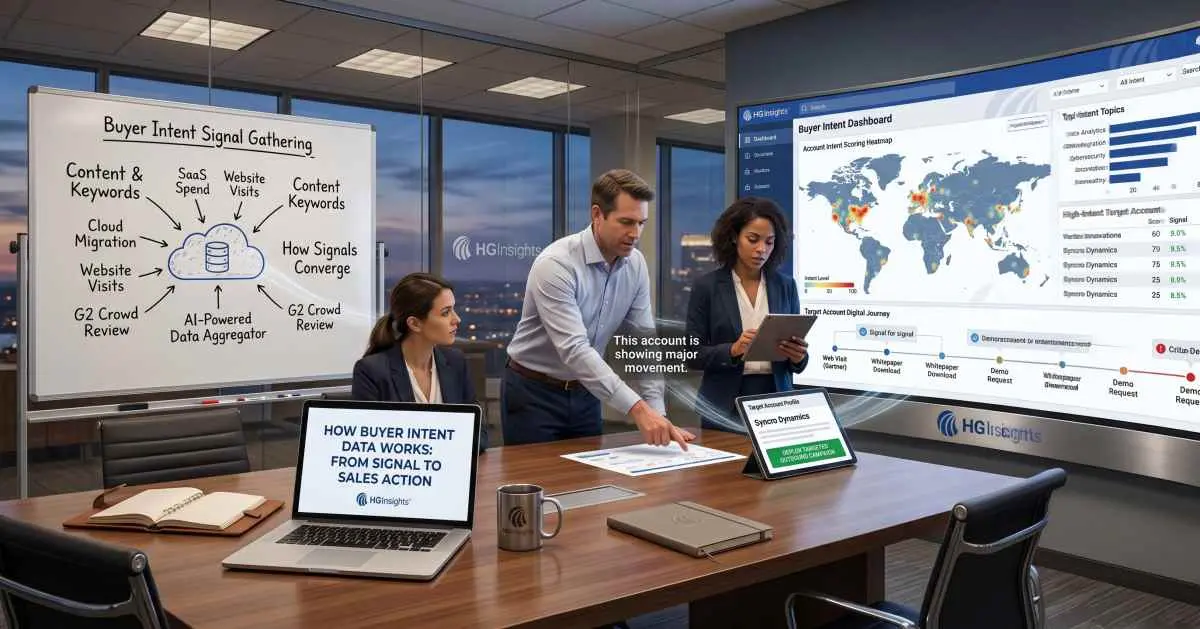
Most GTM teams I talk to understand what buyer intent data is. Fewer understand what it’s supposed to do once it hits their stack. The data shows up in a dashboard, an alert fires, a rep glances at it, and nothing changes. That’s not a signal problem. It’s a workflow problem.
Intent data only pays off when it runs through a clean lifecycle: capture, scoring, routing, outreach. Each stage has its own decisions, and most underperforming intent programs break at a predictable step. This piece walks through that lifecycle end to end.
If you need a quick refresher on the category before getting into workflow, HG Insights has a breakdown of what is buyer intent data and the main sources behind it.
Stage 1: Signal capture
Everything starts with where the signals come from. Intent data is only as useful as the source behind it, and not all sources are built the same.
Three main types feed most intent programs:
- First-party signals. Your own website visits, content downloads, demo requests, pricing page views. High trust, limited coverage.
- Second-party signals. Data shared by a partner, usually through a review site or community where buyers are actively researching. Medium coverage, high intent quality when the source is verified.
- Third-party signals. Aggregated data from the broader web, showing which accounts are consuming content related to specific topics. High coverage, variable intent quality.
The capture stage is where a lot of programs quietly go wrong. Teams buy a third-party intent feed, plug it into Salesforce, and call it done. That works for topic-level awareness, but it doesn’t tell you whether the account is actually in a buying cycle or just reading a blog post.
Stronger programs blend sources. First-party for owned engagement. Second-party from verified buyer communities (this is where sources like TrustRadius matter, since the signals come from real technology buyers researching on the platform). Third-party for broader topic coverage. The blend is what gives the workflow something worth acting on.
Stage 2: Scoring
Raw signals on their own don’t tell a rep what to do. Scoring is what turns a stream of activity into a prioritized list.
A working intent scoring model answers a few questions:
- How strong is the signal? (A demo request outranks a blog view.)
- How recent is the signal? (Last week matters more than last quarter.)
- How concentrated is the activity? (Multiple people at the same account beats one.)
- How relevant is the topic? (Category-specific intent beats generic interest.)
Most teams either overcomplicate this or skip it entirely, but understanding the fundamentals of SEO basics helps clarify how structured systems like scoring should actually work. The overcomplicated version weights 40+ signal types across six decay curves and produces a number no one trusts. The skipped version dumps every intent-flagged account into a list and asks reps to figure out priority themselves.
The middle path is simpler than both. Start with three or four weighted categories (signal strength, recency, topic relevance, account fit) and tune from there. Add complexity only when you can prove it changes conversion. Most teams never need to go beyond that foundation.
Account fit matters as much as intent here. A high-intent account that doesn’t match your ICP is still a bad target. Pair intent scoring with firmographic and technographic filters so the prioritized list reflects fit plus timing, not timing alone.
Stage 3: Routing
Scoring without routing is a dashboard nobody checks. Routing is the step that puts the right accounts in front of the right people, at the right moment, in the system they already use.
A few routing decisions every team has to make:
- Which accounts go to sales vs marketing? Surging accounts with an open opportunity stay with the AE. Surging accounts with no opportunity and no recent engagement go into a nurture or SDR queue.
- How fast does the signal need to move? High-intent surges should route in minutes, not hours. Low-intent signals can batch daily.
- Where does the routing live? CRM alerts, Slack notifications, automated task creation, enriched lead records. Teams that force reps to log into a separate platform to see intent data are adding friction the signal won’t survive.
The cleanest setups push intent signals directly into the CRM so they appear on the account record, with an alert fired to the right rep or channel when the signal crosses a scoring threshold. No rep should have to hunt for the information.
Stage 4: Outreach
This is where the lifecycle either pays off or falls flat. A rep has a prioritized, routed signal in front of them. What they do next determines whether intent data was worth the spend.
A few patterns separate strong outreach from weak outreach on intent signals:
- The message references what the account is actually researching. Not in a creepy “we see you” way, but in a relevant “given what you’re looking at, here’s what usually matters” way.
- The outreach hits a multi-threaded buying center. Intent signals rarely come from one person. Reps who only email the first contact they find miss most of the real decision-makers.
- The cadence matches the surge window. Intent surges decay. A rep who reaches out three weeks after the signal is reaching out after the evaluation has moved on.
This is also where intent data hits its ceiling on its own. The signal tells you an account is researching. It doesn’t tell you the full picture: what stack they already run, what category budget they have, or who inside the account owns the decision. Reps who lean on intent alone can mistime their pitch or talk to the wrong persona, even when the surge data is real.
Stronger outreach pairs intent with three other layers:
- Technographic context, so reps know what stack the account runs before the first message.
- IT spend data, so reps can frame messaging around real budget in the category.
- Buying center detail, so multi-threaded outreach lands with the people who actually make the call.
Those layers turn a raw intent signal into a targeted, informed, timely play. Without them, intent data is just a reason to send more emails.
Where the lifecycle usually breaks
Most underperforming intent programs fail at one of three spots:
- The capture stage is too narrow. One third-party source, no first-party blend, no verified community data. The signal looks thin because it is thin.
- The scoring is either absent or overbuilt. Reps either get a raw feed or a score they don’t trust.
- The outreach doesn’t match the signal. Generic messaging sent after the evaluation window closed, to the wrong contact.
Fix any one of those and intent performance usually jumps. Fix all three and the program starts producing pipeline that competes with sourced-by-sales motion.
Turn intent signals into pipeline with HG Insights
Buyer intent data only works when every stage of the lifecycle works. Capture through verified sources. Scoring that reflects fit and timing. Routing that meets reps where they already work. Outreach that reads the full picture, not just the intent surge.
HG Insights brings that full picture together. Our platform combines verified buyer intent from TrustRadius with technographic intelligence, IT spend data, and buying center context, so every signal reaches reps with the context they need to act on it.
If your team is sitting on intent data that isn’t producing pipeline, book a demo. We’ll walk through where the lifecycle is breaking and how layered intelligence can close the gaps.